Electrical Plug Types: A Global Overview
Navigating the world of electrical plugs and sockets can feel like deciphering a secret code. What works in one country can be completely useless in another, leading to frustrating situations for travelers. This overview explores the diverse landscape of electrical plugs, focusing on the most common types and their characteristics.
The Alphabet Soup of Plugs: Types A to N
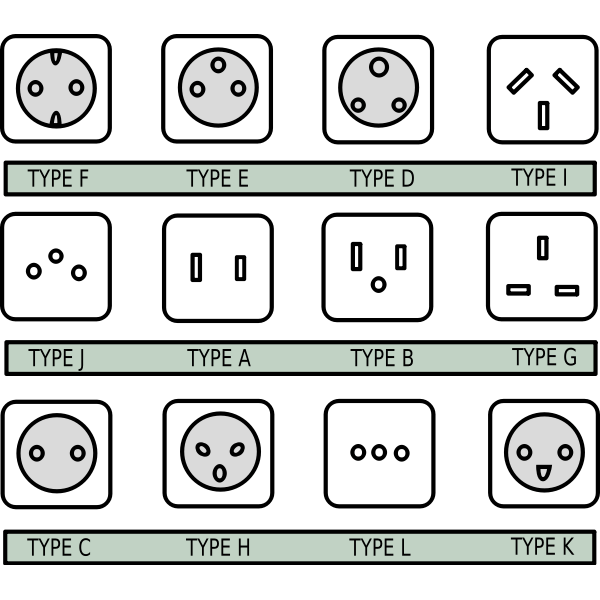
The International Electrotechnical Commission (IEC) categorizes electrical plugs with letters ranging from A to N, though not all are currently in common use. These letters don't necessarily denote any technological superiority or inferiority, but simply represent different physical configurations and standards.
Type A and B: North American Standards
Type A plugs are the familiar two-pronged, ungrounded connectors found in North America, Japan, and some parts of Central and South America. Type B plugs are similar but include a grounding pin, offering an extra layer of safety. Devices designed for Type A can often be used in Type B sockets, but the reverse isn't always true without an adapter.
Type C: The Europlug
Type C plugs, also known as "Europlugs," are two-pronged, round plugs widely used across Europe, except for the UK, Ireland, Cyprus, and Malta. They're often compatible with Type E, F, J, K, and L sockets, making them relatively versatile. However, they are ungrounded, which can be a safety concern with high-power appliances.
Type D: The Old British Standard
Type D plugs are three-round-pin plugs primarily used in India, Nepal, and parts of Africa. Though largely superseded by Type M in India, they still exist in older installations.
Type E and F: Grounded European Plugs
Type E and F plugs are both grounded European plugs. Type E uses a hole for a grounding pin protruding from the socket, while Type F, also known as "Schuko," uses grounding clips on the sides of the plug. Both are common in continental Europe and Russia, and are designed to accept Type C plugs as well.
Type G: The British Standard
Type G plugs, ubiquitous in the UK, Ireland, Malta, Malaysia, Singapore, and parts of the Middle East, are characterized by their three rectangular prongs. They also incorporate a fuse within the plug itself, providing an added layer of protection against overcurrent.
Type H: Israel Specific
Type H plugs are primarily used in Israel and consist of three round pins. While originally unique, some sockets are now designed to also accept Type C plugs.
Type I: Australian and Chinese Standard
Type I plugs feature two flat pins in an inverted V-shape, sometimes with a grounding pin. They're the standard in Australia, New Zealand, China, and Argentina.
Type J: Switzerland Specific
Type J plugs, used in Switzerland and Liechtenstein, have three round pins, similar to Type C, but with an additional grounding pin.
Type K: Denmark Specific
Type K plugs, standard in Denmark and Greenland, are similar to Type C plugs but feature a grounding pin offset from the other two.
Type L: Italy Specific
Type L plugs, used in Italy and Chile, have three round pins arranged in a line. They come in two sizes (10 amp and 16 amp), so adapters may be required.
Type M: South Africa Specific
Type M plugs are large, three-round-pin plugs primarily used in South Africa, Swaziland, and Lesotho. They are often used for larger appliances and are similar to, but larger than, Type D plugs.
Type N: Brazil Specific
Type N plugs, now standard in Brazil, have two round pins and a grounding pin. The grounding pin is positioned slightly above the center line. They're designed to be compatible with both 10A and 20A sockets.
Voltage and Frequency Considerations
While plug adapters can address the physical incompatibility of plugs and sockets, they do not convert voltage or frequency. Countries use different voltage standards (typically 100-127V or 220-240V) and frequencies (50 Hz or 60 Hz). Using an appliance designed for one voltage in a system with a different voltage can damage or destroy the device, or even pose a fire hazard. Always check the voltage and frequency requirements of your appliances and use a voltage converter if necessary.
 1300×1390 types electrical plugs types features from www.elevate.in
 942×628 diagram doffernt types plugs types electrical plugs from schematicinnbyggt2wp.z21.web.core.windows.net
 960×819 types plugs world coolguides electrical installation from br.pinterest.com
 700×700 types electrical plugs family handyman from www.familyhandyman.com
 848×426 power outlets explained plugs sockets from www.dignited.com
 1999×1434 types electrical plugs types features benefits eu from evbn.org
 791×763 electrical plug connector types electric from electrichow.com
 1280×1810 electrical outlet plug types from guidelistitinfinitary.z13.web.core.windows.net
 939×579 figure power cord nema p plug ultimate buying from shfycable.com
 1600×1367 electrical plug types stock vector illustration type from www.dreamstime.com
 600×600 plug types svg from freesvg.org
 2000×2000 plug socket types from www.worldstandards.eu
 764×510 types plugs electronics gilbert kasper blog from exoefearu.blob.core.windows.net
 638×826 outlet plug types from www.slideshare.net
 474×367 worldwide plugs comparison fourtwo electronics from www.powercordexpert.com
 900×600 comprehensive guide power adapters types safety from www.sfcable.com
 640×480 turkey plug type adapters voltage from fethiyenow.com
 710×770 pin conectores from www.pinterest.com.mx
 470×270 types plugs country electrical engineering updates from electricalupdates1.blogspot.com
 1024×1024 power adaptor plug types christy nathan blog from storage.googleapis.com
 1999×1435 types electrical plugs from www.iqsdirectory.com
 1080×1350 raa charge plug types explained raa daily from daily.raa.com.au
:max_bytes(150000):strip_icc()/Typesofvehicleplugs_svetolk_iStock_GettyImagesPlus-5461dcc83ddd4b35b248dcb6a018b559.jpg) 1500×1000 electric plug types from ar.inspiredpencil.com
1500×1000 electric plug types from ar.inspiredpencil.com
 612×408 electric plug types stock pictures royalty images from www.istockphoto.com